
Architecture
Cross-Cutting Layer
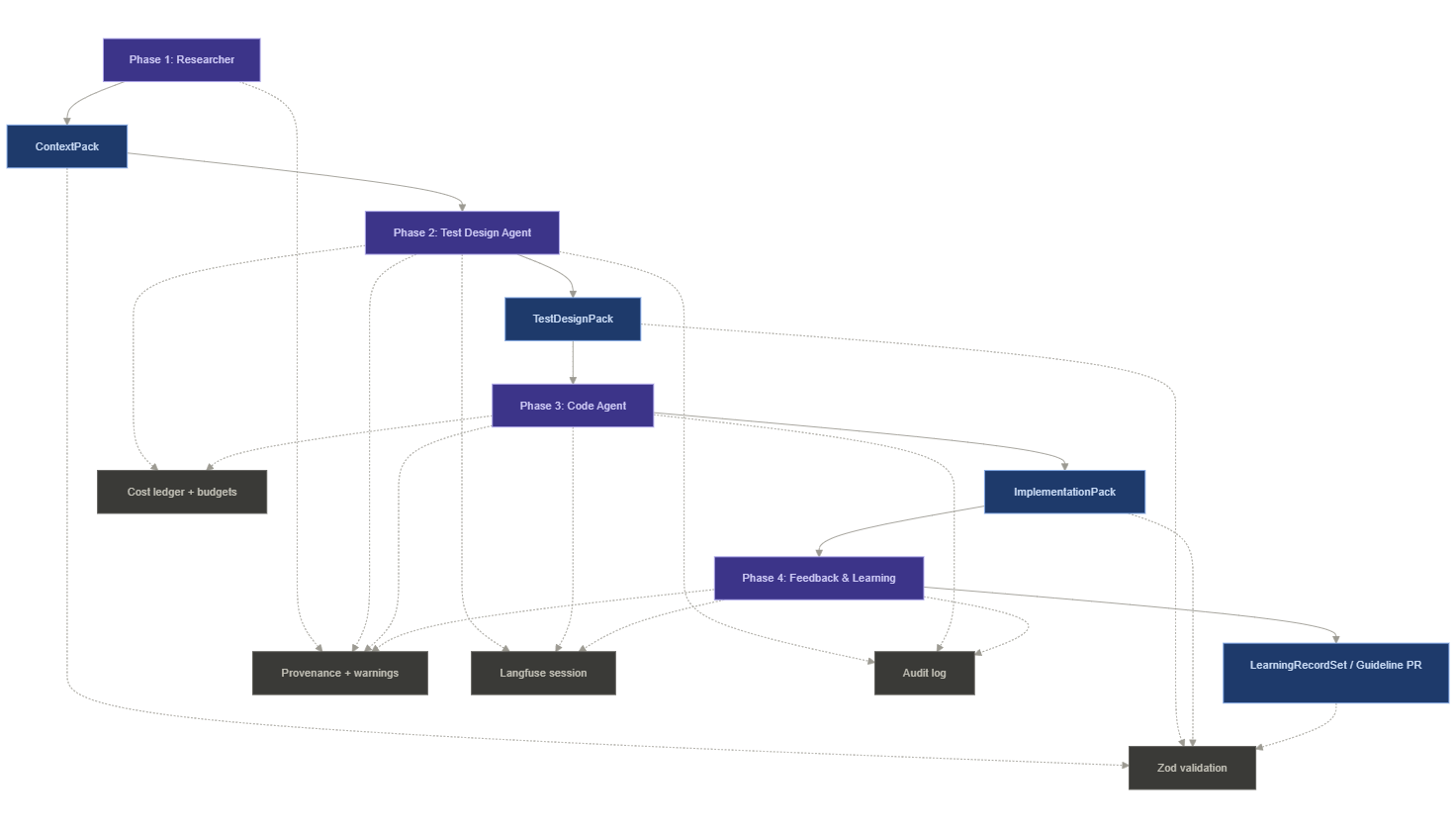
What the layer provides
| Concern | Why it exists | Main implementation |
|---|---|---|
| Bounded artifacts | Prevents agent output from becoming an unreviewable black box. | Zod schemas plus per-artifact writers. |
| Provenance | Shows where evidence, scenarios, uploads, and tool calls came from. | provenance.tools[], source evidence, retrieval citations, evidence graph. |
| Warnings | Keeps non-fatal issues visible without crashing the whole run. | warnings[] on phase artifacts. |
| Audit log | Records consequential actions for governance and review. | Append-only audit.jsonl. |
| Cost ledger | Tracks per-run and per-day spend. | Append-only cost-ledger.jsonl. |
| Budget gate | Prevents unattended runs from overspending. | policy.budgets in .agents/testonaut.config.json. |
| Langfuse telemetry | Tracks LLM calls, sessions, tokens, cost, latency, inputs, outputs, and phase metadata. | OpenTelemetry + OpenInference export to Langfuse. |
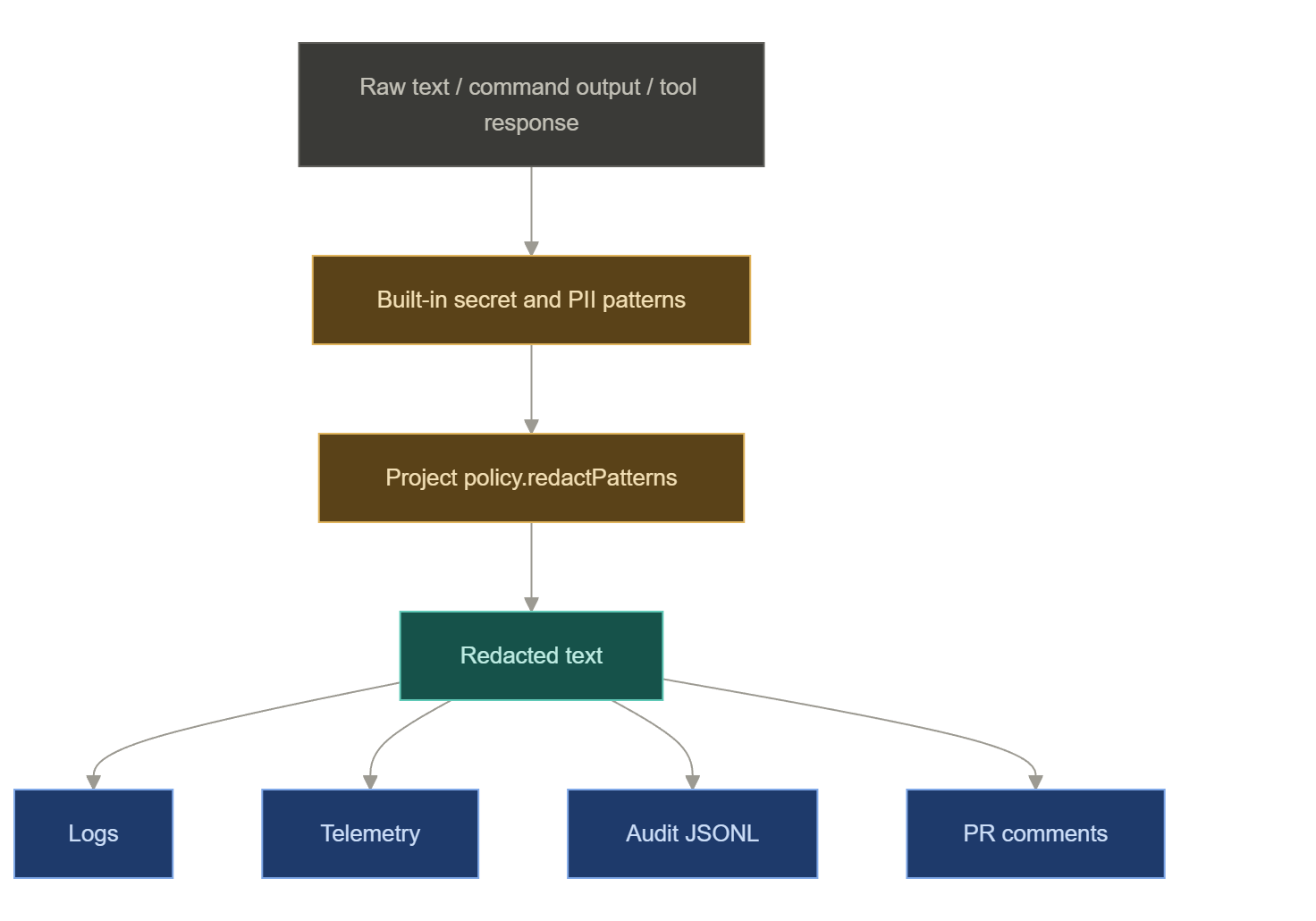
| Redaction | Prevents secrets and PII from leaking into logs, telemetry, audit, or comments. | Built-in redactor plus policy.redactPatterns. |
Zod artifacts
Zod artifacts are the main contract between phases. Each phase emits a structured JSON artifact that must validate before it is written or passed forward. This gives Testonaut three properties:
- Determinism at the boundary: the next phase receives a known shape, not arbitrary model text.
- Traceability: scenarios, source evidence, links, warnings, and tool calls remain inspectable after the run.
- Versioning: each artifact carries
schemaVersion, so future migrations can be handled intentionally.

Main artifacts
| Artifact | Produced by | Written as |
|---|---|---|
ContextPack | Phase 1 Researcher | out/<KEY>/context.json and context.md |
TestDesignPack | Phase 2 Test Design Agent | test-design.json, test-design.md, feature files, optional manual-tests.md |
ImplementationPack | Phase 3 Code Agent | implementation.json and implementation.md |
LearningRecordSet | Phase 4 Learning Engine | Proposed guideline changes |
ReadinessReport | Readiness checks | CLI output/report |
EvalReport | Evaluation harness | CLI output/report |
Why JSON plus Markdown
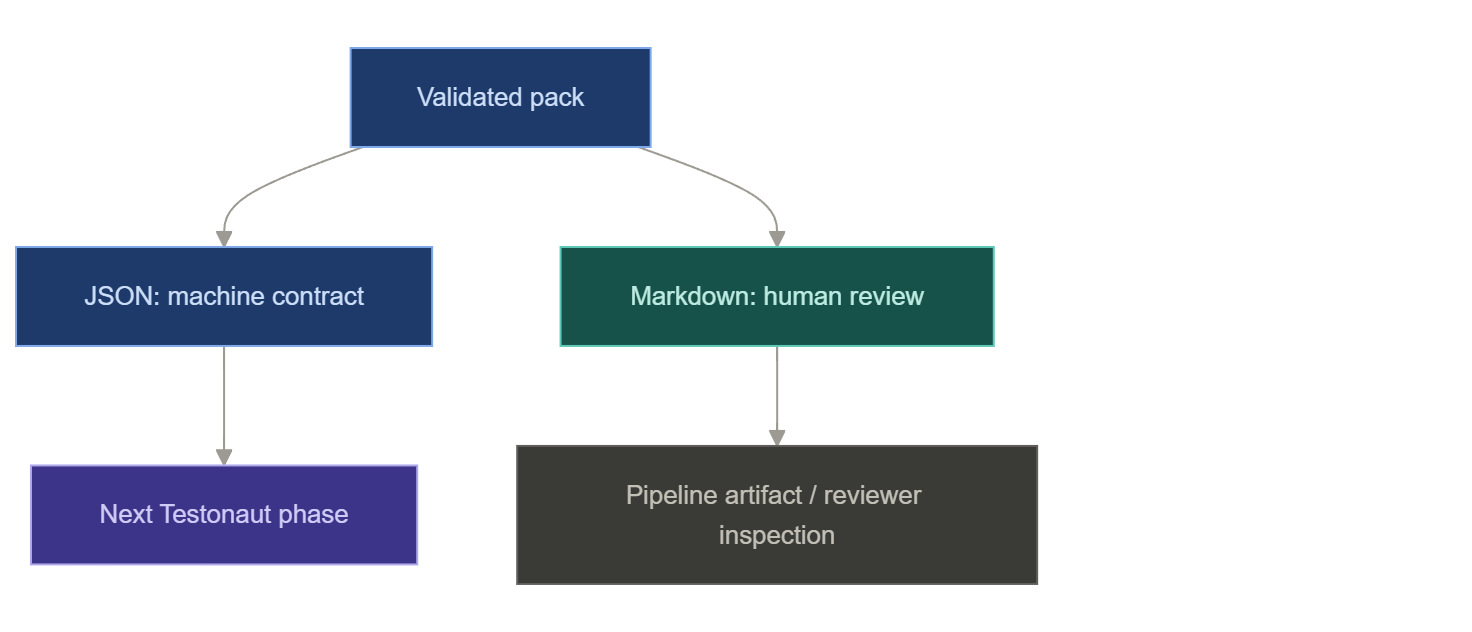
Each major pack is written twice: JSON is the machine-readable source of truth for the next phase and for audits; Markdown is the human-readable companion for review, pipeline artifacts, and debugging.
Audit log
The audit log records consequential actions as append-only JSONL — used for governance and review, not as input to future decisions. Default path out/audit.jsonl, overridable with TESTONAUT_AUDIT_LOG. Each line is one event:
{
  "at": "2026-06-17T12:00:00.000Z",
  "action": "pr.raised",
  "actor": "implement-tests",
  "target": "FINT-1056",
  "detail": {
    "status": "raised",
    "url": "https://...",
    "branch": "testonaut/FINT-1056"
  }
}| Action | Meaning |
|---|---|
run.started | A CLI workflow started. |
design.created | A validated TestDesignPack was created. |
xray.uploaded | Tests were uploaded or applied to Xray. |
pr.raised | A pull request was raised, updated, found, skipped, or failed. |
pr.fix-applied | Phase 4 applied or attempted a PR feedback fix. |
rule.proposed | Phase 4 proposed a Markdown guideline learning PR. |
budget.breached | A run or day cost budget was exceeded. |
run.completed | A workflow completed and wrote final status. |
Reading the audit log
testonaut audit
testonaut audit --target FINT-1056
testonaut audit --action pr.raised --limit 20
testonaut audit --json
Redaction before audit
Audit entries pass through the redactor before they are appended, protecting common secret and PII shapes: OpenAI and Anthropic API keys, GitHub tokens, Slack tokens, AWS access key ids, bearer/basic auth headers, private keys, email addresses, and password / secret / token / api_key style values. Project-specific patterns can be added:
{
  "policy": {
    "redactPatterns": [
      "customer-[0-9]{6}",
      "internal-account-[A-Za-z0-9-]+"
    ]
  }
}
Invalid custom regex patterns are skipped rather than crashing the run.
Cost ledger and budgets
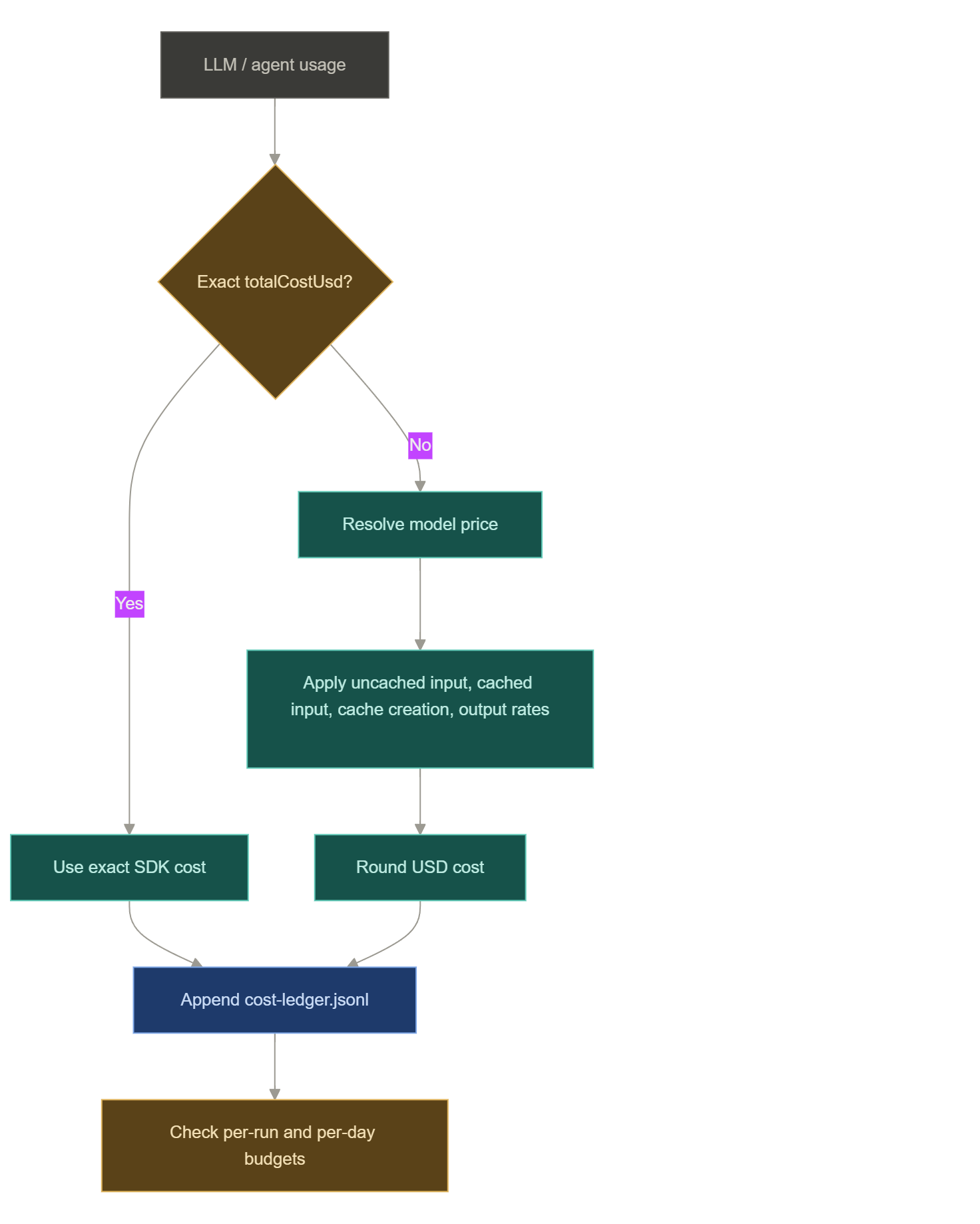
Testonaut tracks LLM spend in an append-only cost ledger at out/cost-ledger.jsonl (override with TESTONAUT_COST_LEDGER). Each entry records the timestamp, calendar day, measured or estimated run cost, issue key, and the CLI command that produced the cost.
| Budget | Behavior |
|---|---|
maxCostPerRunUsd | Compares the current run cost against the per-run limit. |
maxCostPerDayUsd | Sums today's entries from the ledger and compares against the daily limit. |
| Breach | Emits budget.breached to the audit log and warns or halts depending on workflow stage. |
How costs are calculated
Testonaut prefers exact cost when the SDK provides it. When exact cost is unavailable, it estimates from token counts and a model price table. The estimator understands uncached input tokens, cached input tokens, Anthropic cache-creation tokens, output tokens, and reasoning tokens where reported. Custom or Azure deployment names can be priced with:
TESTONAUT_MODEL_PRICES='{"my-azure-deployment":{"input":1.75,"cachedInput":0.175,"output":14}}'Langfuse observability
Testonaut uses OpenTelemetry and OpenInference instrumentation, exported to Langfuse. Telemetry is optional; when disabled, the same workflows run without loading the OpenTelemetry stack. Minimum environment:
OTEL_ENABLED=true
OTEL_PROVIDER=langfuse
OTEL_PUBLIC_KEY=<langfuse-public-key>
OTEL_SECRET_KEY=<langfuse-secret-key>
OTEL_ENDPOINT=https://cloud.langfuse.com
OTEL_PROJECT_NAME=testonaut
If OTEL_SESSION_ID is not provided, ticket workflows use the Jira issue key as the session id — jira:<ISSUE-KEY> — grouping the Researcher, Test Design, Implementation, and Feedback spans for one ticket into one Langfuse session.
What Langfuse receives
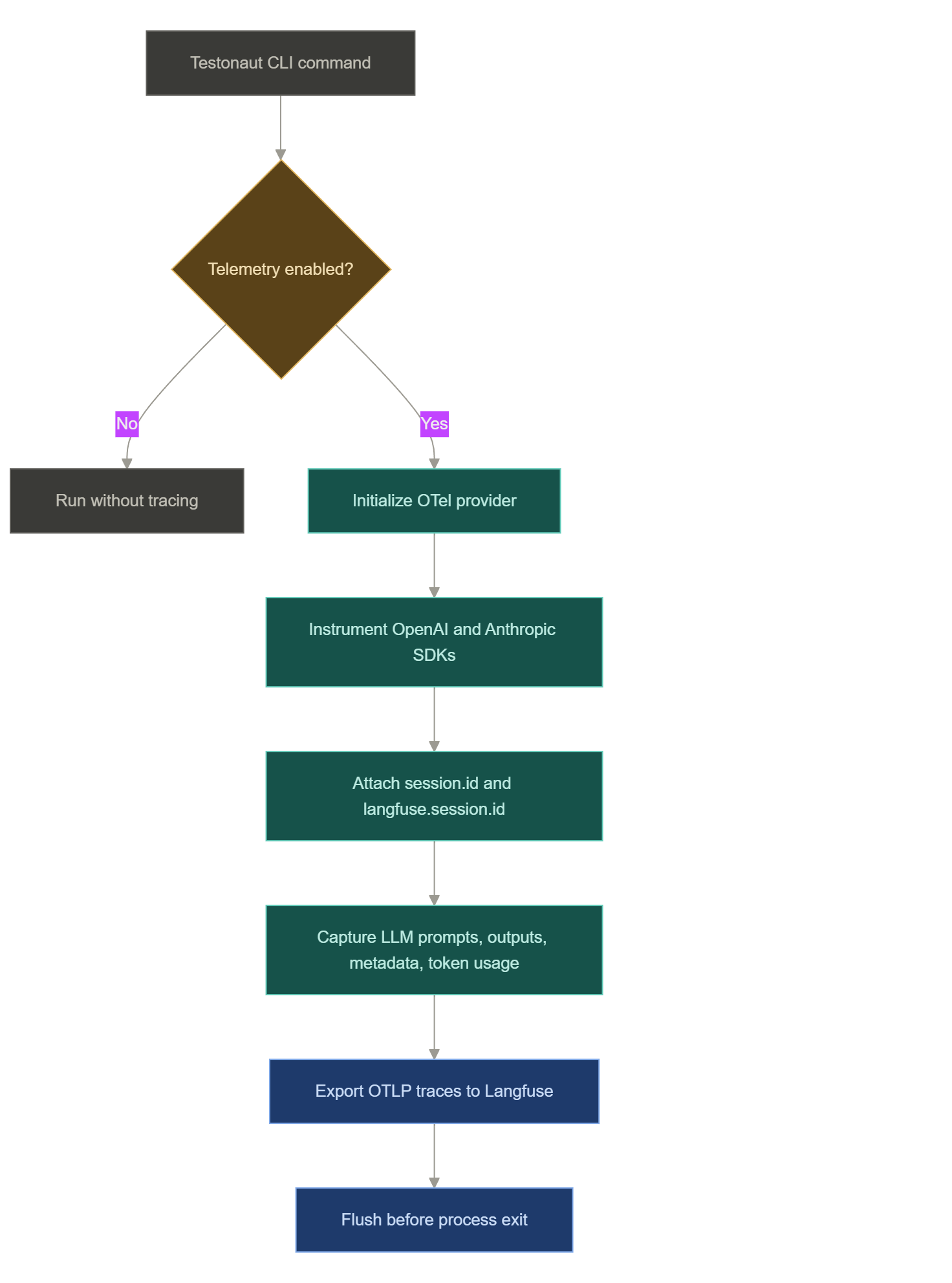
| Data | Where it appears |
|---|---|
| Session and user id | session.id, user.id and Langfuse equivalents. |
| Workflow, issue, phase | workflow.issue, workflow.phase (implementation, healing, PR feedback fix). |
| Model and tokens | Model name plus input, output, cached-input, cache-creation, and reasoning tokens. |
| Cost and latency | Exact SDK cost or cache-aware estimate via cost_details; span duration. |
| LLM input/output | Text-client spans include prompt and response payloads for design/research calls. |
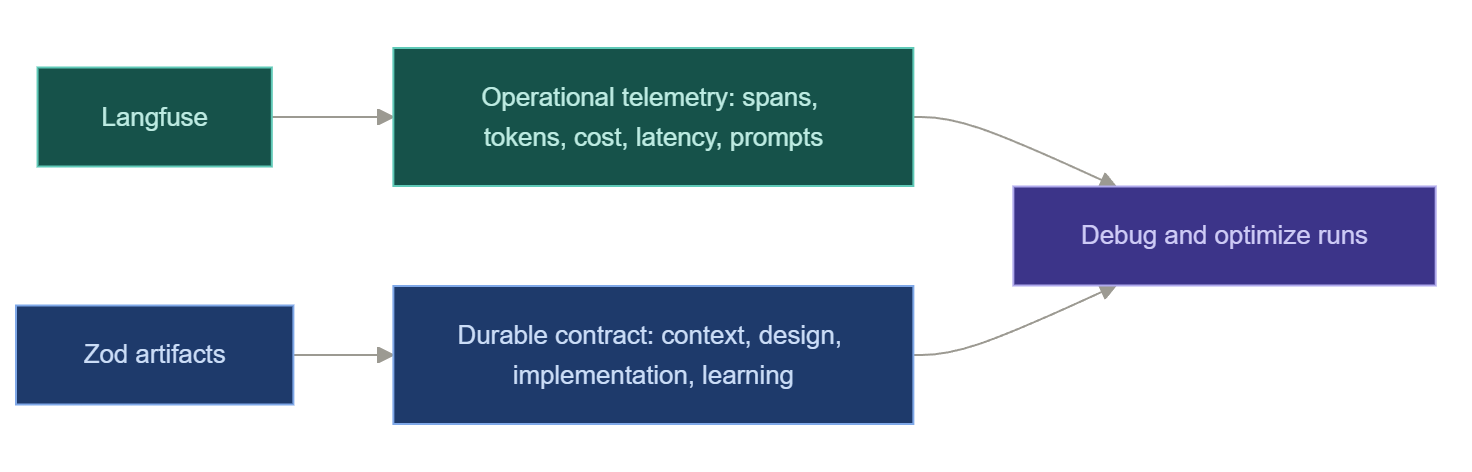
Why Langfuse and artifacts are both needed
- Langfuse answers operational questions: how many LLM calls per ticket, which phase spent the most tokens, did cached input reduce cost, how long did each call take.
- Artifacts answer product and audit questions: which Jira comments and Confluence pages were used, which AC produced this scenario, which Xray tests were created, which files changed, which warnings were attached.
Redaction and secret handling
The layer assumes secrets may appear in tool responses, command output, environment-derived values, or reviewer comments. Before text leaves the process, Testonaut applies redaction to logs, telemetry span payloads, audit entries, written artifacts, and PR comments. MCP server configuration also supports environment-variable expansion so API tokens can live in .env or pipeline secret variables rather than in repository config.
Configuration summary
Repository config
{
  "schemaVersion": "1.0.0",
  "product": "example-product",
  "policy": {
    "gates": {
      "acCoverage": "required",
      "riskCoverage": "warn",
      "humanReviewBeforeUpload": true,
      "humanReviewBeforePr": false
    },
    "budgets": {
      "maxCostPerRunUsd": 5,
      "maxCostPerDayUsd": 25
    },
    "redactPatterns": []
  },
  "pr": {
    "mention": "@testonaut",
    "maxIterationsPerPr": 5
  }
}
This config is itself Zod-validated. Invalid JSON or invalid fields fail fast with readable validation errors.
Runtime environment
| Variable | Purpose |
|---|---|
OTEL_ENABLED | Enables telemetry. |
OTEL_PROVIDER=langfuse | Selects Langfuse export. |
OTEL_PUBLIC_KEY | Langfuse public key. |
OTEL_SECRET_KEY | Langfuse secret key. |
OTEL_ENDPOINT | Langfuse endpoint. Defaults to Langfuse Cloud when omitted. |
OTEL_PROJECT_NAME | Project name shown in telemetry. |
OTEL_SESSION_ID | Optional fixed session id. Otherwise the Jira issue session is used. |
OTEL_USER_ID | Optional user attribution. Pipeline user variables are also detected. |
TESTONAUT_AUDIT_LOG | Optional audit log path override. |
TESTONAUT_COST_LEDGER | Optional cost ledger path override. |
TESTONAUT_MODEL_PRICES | Optional JSON price table override. |
Failure and safety behavior
| Situation | Behavior |
|---|---|
| Artifact does not validate | The phase fails before hand-off. |
| Optional context fetch fails | The run records a warning and continues when possible. |
| Audit write fails | The audit helper swallows the write error so the run is not failed by a logging problem. |
| Cost ledger missing | Day cost reads as 0; future writes recreate the ledger. |
| Budget breached | Emits budget.breached; implementation can halt before overspending further. |
| Langfuse disabled | No telemetry stack is initialized. |
| Langfuse flush fails | Warning is printed; process still exits. |
| Missing Langfuse keys | Langfuse telemetry configuration fails loudly when enabled. |
| Invalid redaction regex | Pattern is skipped; run continues. |
Why this layer matters