
Agent Phases
Phase 1: Researcher Agent
ContextPack that the Test Architect can trust — the Test Architect should not be guessing from a short ticket summary.It reads the story, comments, linked tickets, attachments, Confluence references, development links, and already-linked Xray tests. It normalizes all of that into one schema, adds traceability through an evidence graph, optionally enriches attachments with text extraction and vision analysis, and records warnings instead of silently dropping partial failures.
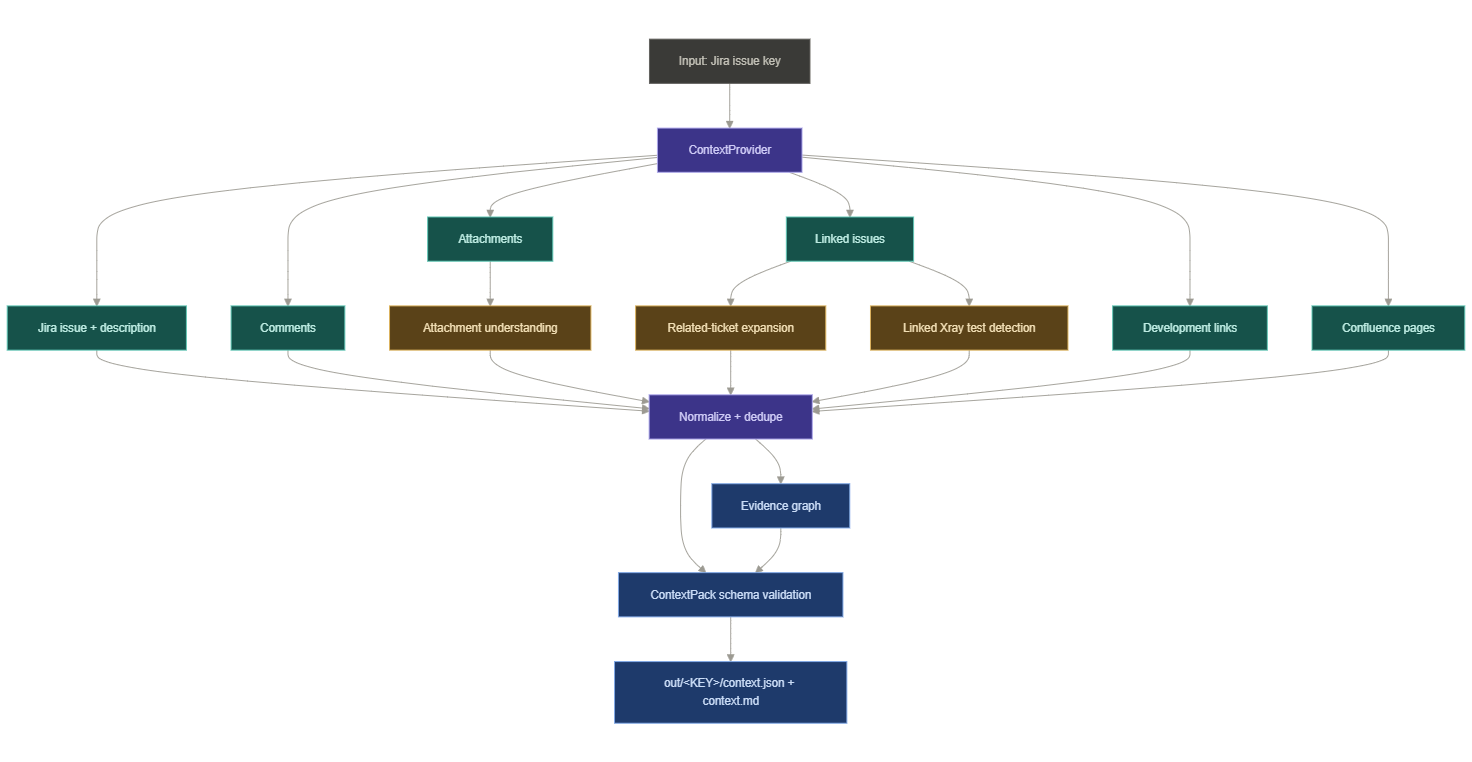
What the Researcher produces
The Researcher emits a Zod-validated ContextPack — the contract between context gathering and test design.
| Section | What it contains | Why it matters |
|---|---|---|
ticket | Key, title, type, status, assignee, reporter, labels, components, links | The identity and metadata of the story under test. |
description | Structure-preserving ticket description text | The primary requirement source. |
comments | Paginated Jira comments, normalized and deduplicated | QA notes, dev clarifications, edge cases — often the real acceptance detail. |
attachments | Metadata plus optional extracted text or vision summaries | Screenshots, mockups, feature files, JSON examples, logs. |
relatedTickets | Expanded bodies of non-test linked tickets | Epic, parent, subtask, related story, or bug context. |
xrayTestCases | Already-linked Xray Test issues | Lets the design phase avoid duplicate test cases. |
development | Branch and pull request links from Jira development information | Shows existing implementation activity around the story. |
confluencePages | Linked Confluence pages, hydrated when credentials are available | Pulls in deeper specs and design notes. |
evidenceGraph | Typed nodes and edges connecting all evidence | Traceability from requirement to evidence source. |
retrievalCitations | Optional citations from deep research | Focused evidence selected by the tool-using researcher. |
provenance | Which tools/methods were called and whether they succeeded | Auditability and debugging. |
warnings | Non-fatal failures and caps | Makes partial context visible instead of hidden. |
Source integration model
The Researcher talks to context sources through a single ContextProvider interface. Today the primary implementation is AtlassianRestSource, which wraps Jira Cloud and Confluence REST APIs. The provider seam matters because future or interactive sources — such as Rovo/MCP-style providers — can be added without rewriting the Researcher.
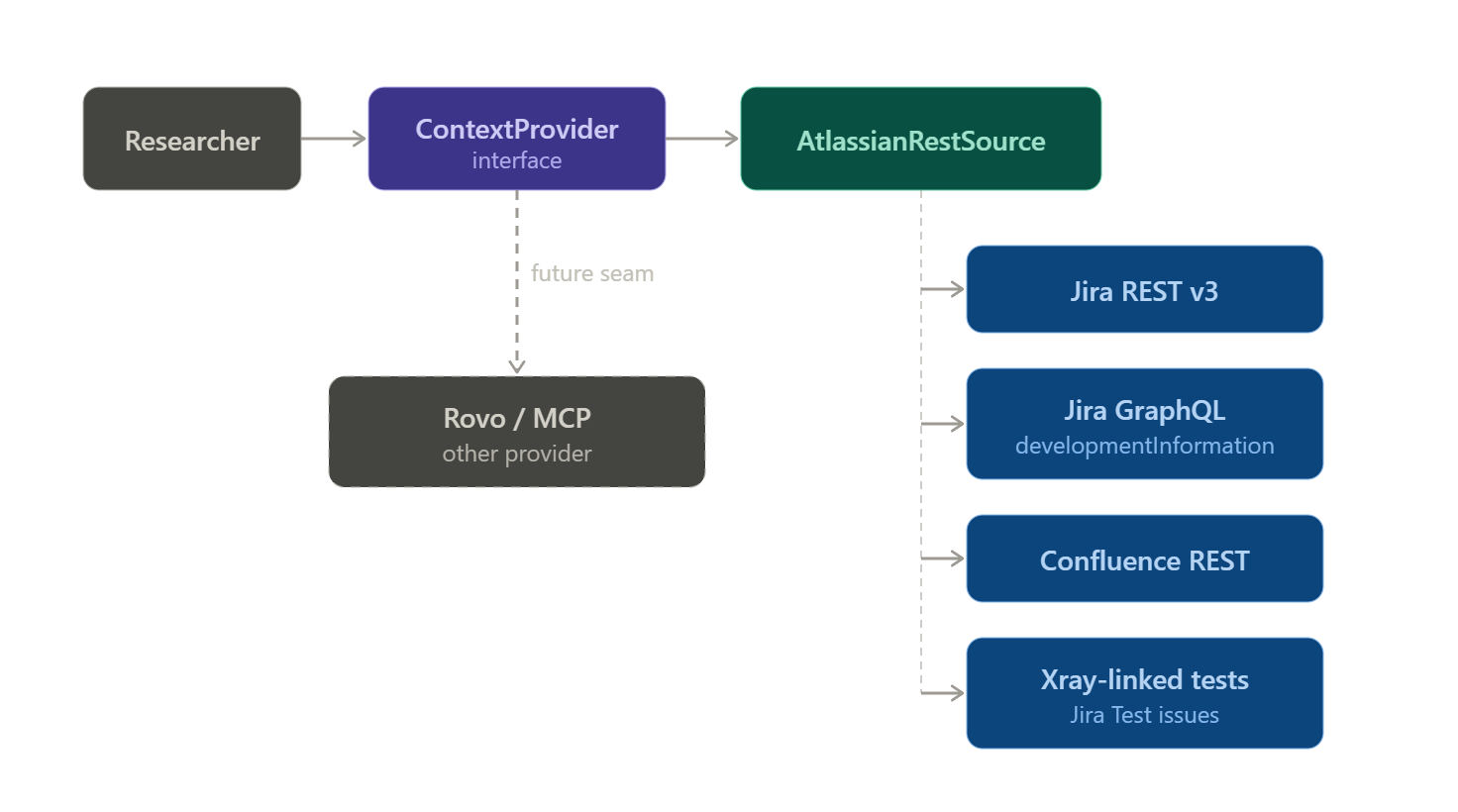
The Jira source gathers:
- the issue itself using Jira REST v3;
- comments, with pagination;
- attachments and issue links;
- development information through Jira GraphQL, including branches and pull requests;
- remote links that point to Confluence pages;
- linked Jira Test issues that represent already-existing Xray coverage.
Every external call records tool provenance: method, tool name, timestamp, success/failure, and message when available.
ADF to Markdown fidelity
Jira and Confluence content often starts as Atlassian Document Format rather than plain text. Flattening that content loses important test detail, especially when acceptance criteria are inside tables or panels. The context layer converts rich Atlassian content into structure-preserving Markdown, keeping headings, lists, tables, panels and callouts, code blocks, inline links and smart-card references, and inline formatting.
Why it matters
Linked-ticket expansion
A user story rarely contains all of the requirement detail by itself. The Researcher expands non-test linked tickets so the design can account for parent, epic, subtask, bug, or related-story context.
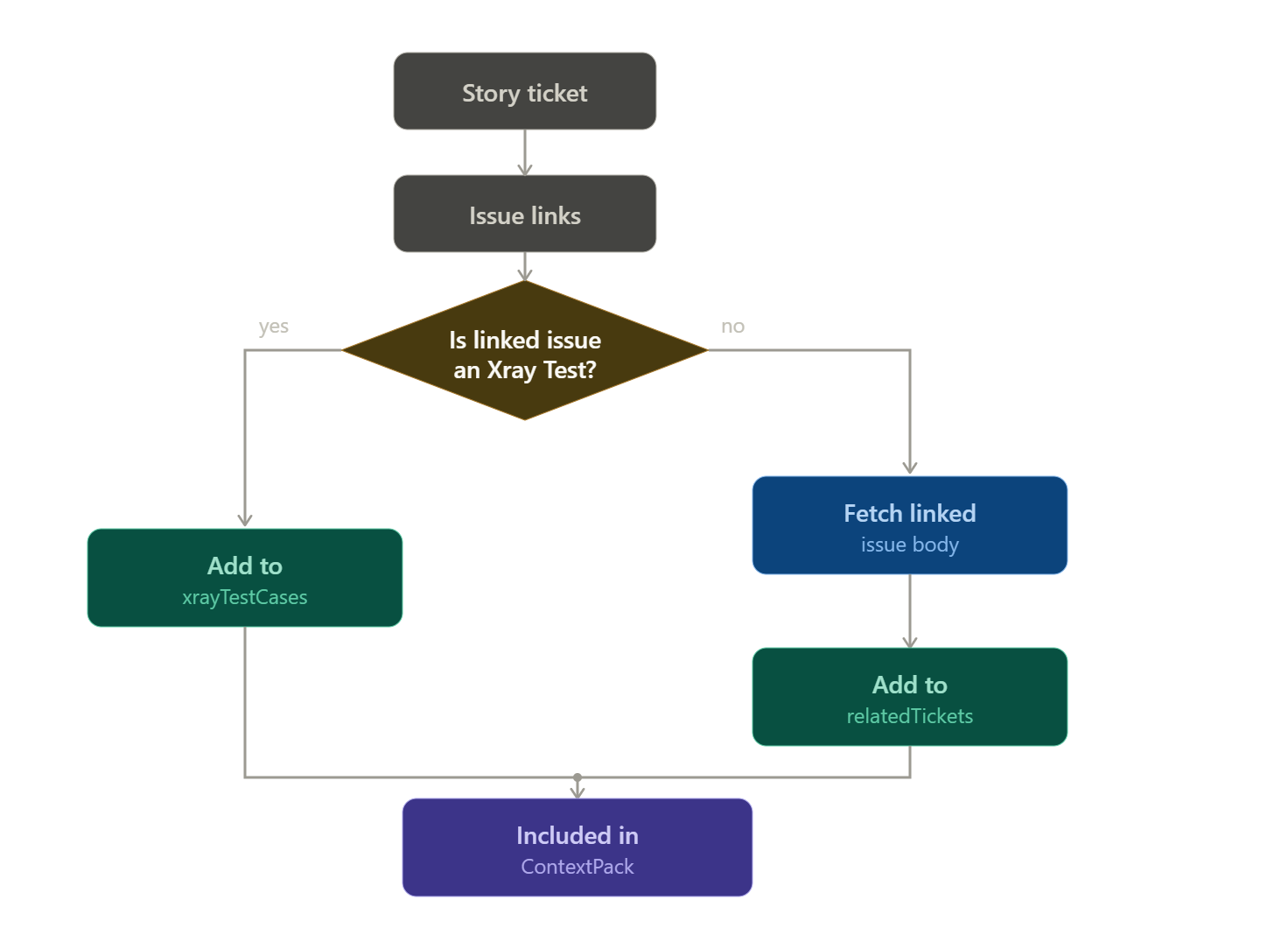
Expansion is bounded. The default is direct linked tickets only, controlled by context.linkedTicketDepth. The Researcher also caps how many related tickets it expands in a run — if there are too many, the extras become a warning rather than triggering an unbounded crawl.
Attachment understanding
Attachments are treated as first-class evidence. The Researcher keeps attachment metadata by default and, when enabled (context.attachmentUnderstanding, default on), downloads and understands supported attachment content.
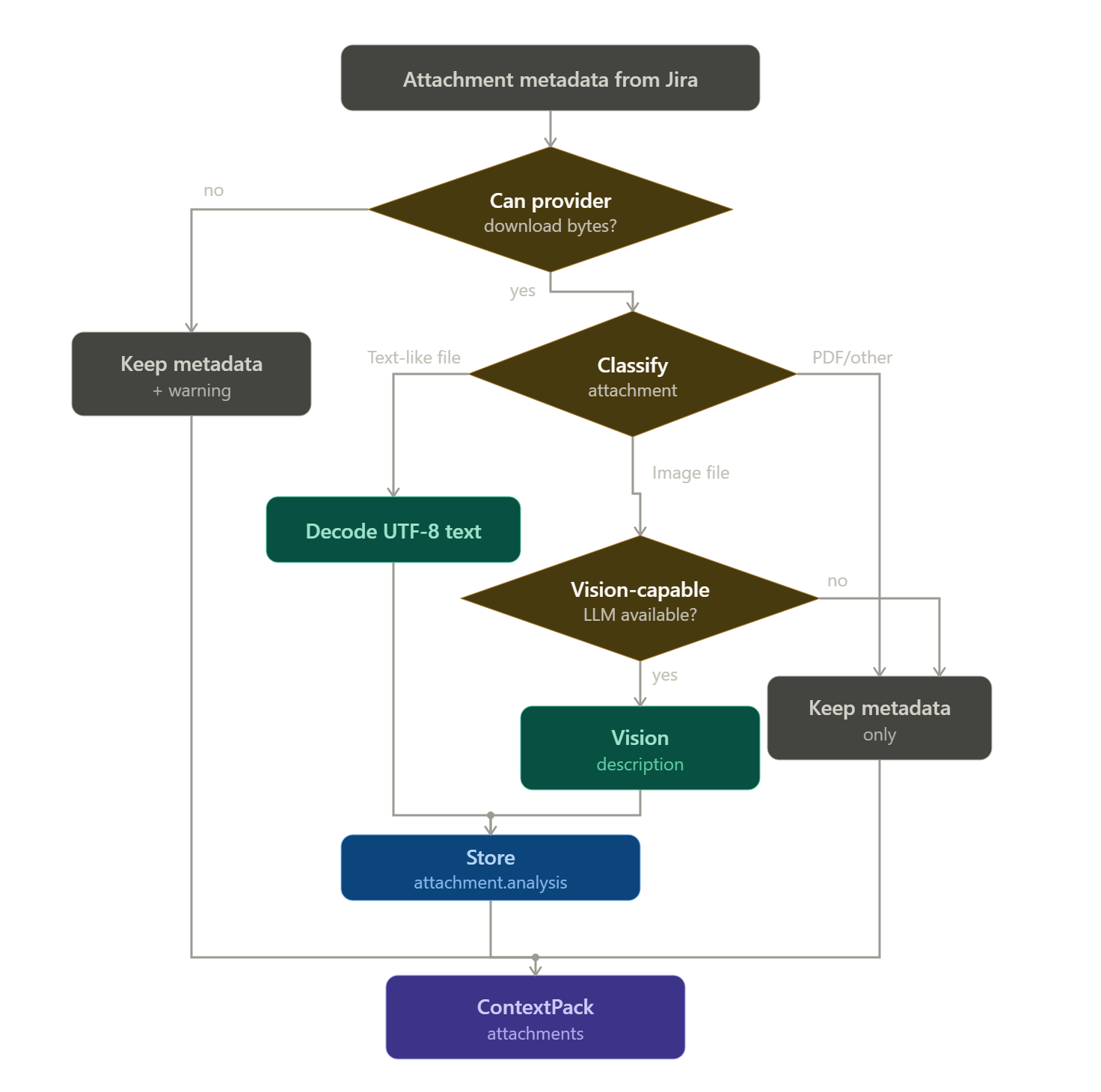
Text attachment analysis
Text-like files (.txt, .md, .csv, .json, .xml, .yaml, .feature, .log, config files, HTML) are downloaded and decoded as UTF-8. The extracted content is stored on the attachment as analysis with analysisSource = "text-extraction". Large text is visibly truncated so readers know there was more content.
Vision analysis for images
Image attachments are sent to a multimodal LLM only when a vision-capable client is available. The image is base64 encoded and sent with a QA-specific prompt that asks the model to describe testable details:
- visible UI elements and labels;
- enabled, disabled, selected, loading, empty, and error states;
- validation messages and implied flows;
- data shown on the screen;
- constraints or rules visible in the design.
The prompt explicitly asks the model to stay factual and not invent behavior that is not visible. The output is stored as analysis with analysisSource = "vision", so the Test Architect can treat the image summary as another evidence source.
Attachment guardrails
| Guardrail | Behavior |
|---|---|
| Same-origin credential guard | Jira credentials are attached only when the attachment URL shares the configured Jira origin. Redirected or external URLs do not receive the token. |
| Text cap | Text analysis is capped by number of attachments and characters per attachment. |
| Image cap | Image analysis is capped by image count and byte size. |
| Non-fatal errors | Failed downloads, oversized images, missing model capability, or unsupported file types become warnings, not hard failures. |
Evidence graph
The evidence graph is the Researcher's traceability backbone. It converts the context into typed nodes and edges so later phases can say exactly where a requirement or scenario came from.
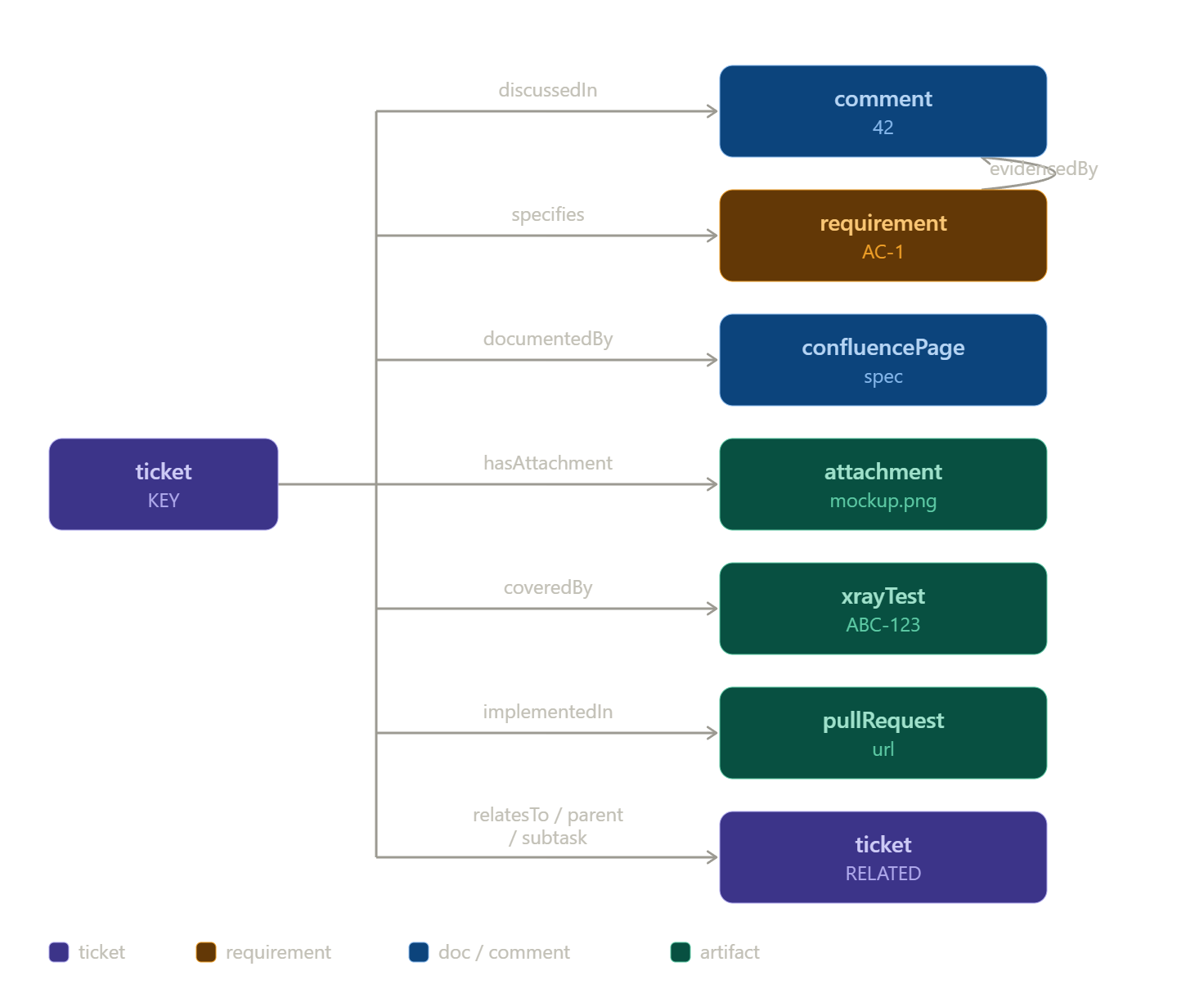
The graph starts with the ticket and links it to comments, Confluence pages, attachments, related tickets, existing tests, branches, and pull requests. After the Test Architect extracts acceptance criteria, the graph is rebuilt so requirement nodes can point back to their source evidence. This is what allows downstream design artifacts to carry sourceEvidence instead of untraceable claims.
Knowledge index and deep research
For large tickets, sending all context to the LLM at once is expensive and can be less accurate. Testonaut builds a lightweight BM25 knowledge index over the context corpus — the ticket description, comments, Confluence bodies, related-ticket descriptions, and attachment analyses. BM25 is deterministic and does not require an embedding API, so it is cheap, testable, and stable in CI.
Optional --deep tool-using researcher
By default, the Researcher is mostly deterministic: fetch, normalize, analyze, validate. With design-tests --deep, Testonaut adds a bounded LLM-driven retrieval loop. The tool protocol is intentionally small and strict — the LLM must return exactly one JSON action at a time:
| Tool | Purpose |
|---|---|
search_context(query, topK) | Search the BM25 index for focused evidence. |
expand_ticket(key) | Fetch the body of an allowed linked non-test ticket. |
finish() | Stop once enough evidence has been gathered. |
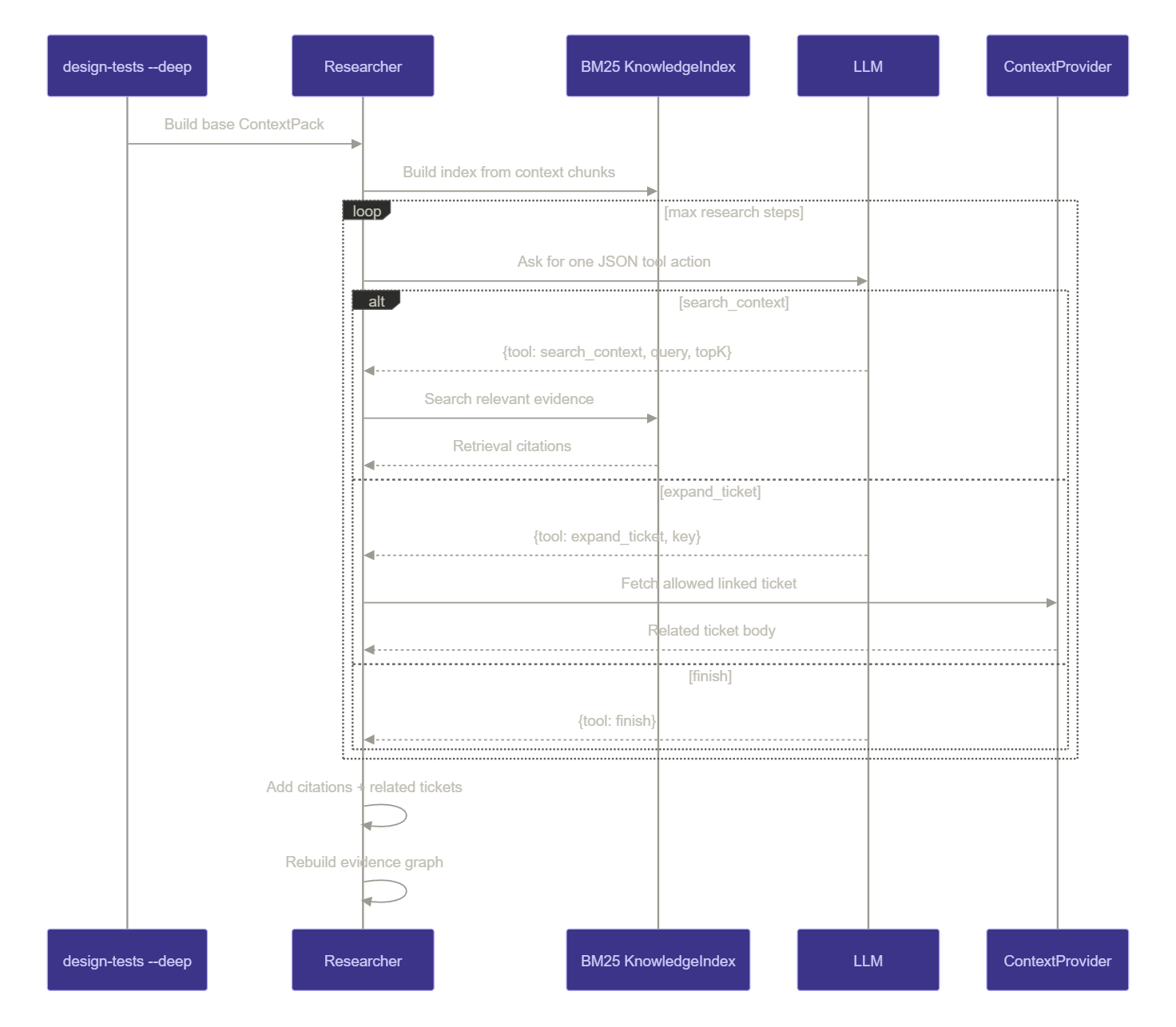
The loop is bounded by a step budget. If the model cannot parse or stops late, the run records warnings and continues with the evidence gathered so far.
Where MCP fits
It is useful to separate two ideas:
- Researcher context sources: the current Researcher gathers ticket context through the
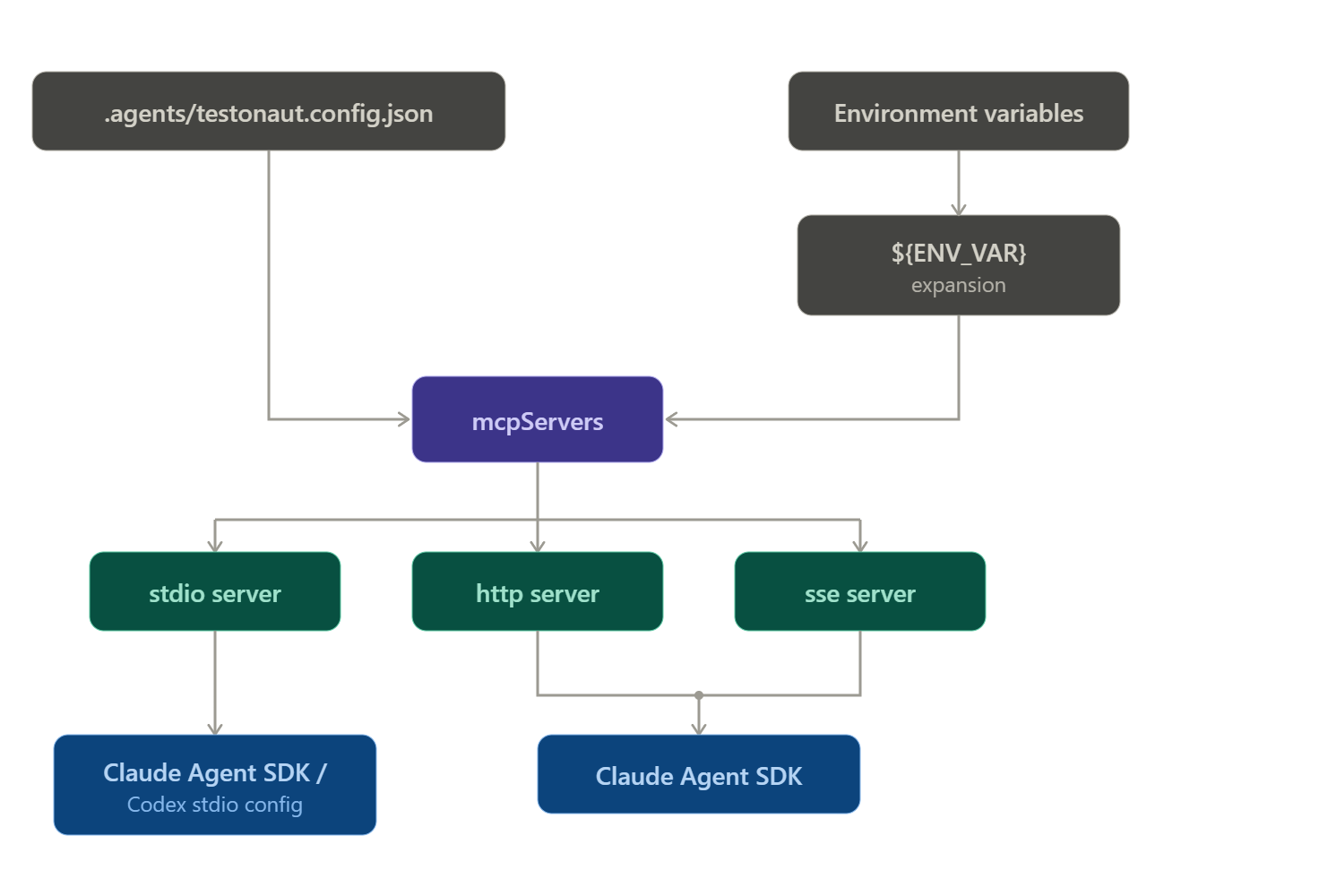
ContextProviderseam — primarily Jira/Confluence REST today, ready for future Rovo/MCP-style providers. - Implementation and exploration tools: configured MCP servers are passed to downstream code-agent phases. Playwright MCP can explore the running UI and collect real locators; Figma MCP can provide design context when configured.
MCP server configuration lives in .agents/testonaut.config.json under mcpServers and supports stdio, http, and sse transports. Secrets are not stored inline — values can reference environment placeholders such as ${FIGMA_TOKEN}, expanded at runtime.
Key takeaway
Failure behavior and guardrails
The Researcher is designed to degrade visibly rather than fail silently.
| Situation | Behavior |
|---|---|
| Comments cannot be fetched | Continue with issue description and add a warning. |
| Attachments cannot be downloaded | Keep metadata and add a warning. |
| Vision model is unavailable | Skip image descriptions; keep attachment metadata. |
| Confluence page cannot be hydrated | Keep the remote-link metadata and add a warning. |
| Linked-ticket expansion exceeds cap | Expand what fits and warn about skipped links. |
| Jira development GraphQL is unavailable | Continue with empty branch/PR lists and add a warning. |
| Deep research hits its step budget | Keep gathered citations and warn that the budget stopped the loop. |
Configuration knobs
| Setting | Default | Effect |
|---|---|---|
context.linkedTicketDepth | 1 | Controls whether direct linked tickets are expanded. 0 disables expansion. |
context.attachmentUnderstanding | true | Controls whether attachment content is downloaded and analyzed. |
--deep | off | Enables the bounded LLM retrieval loop before test design. |
mcpServers | {} | Makes MCP tools available to downstream agent phases. |
| Jira/Confluence env vars | required | Provide credentials and base URLs for context gathering. |
Why this phase matters