
Getting Started
Testonaut Documentation
Testonaut is an end-to-end AI test agent that closes the loop from a Jira requirement to tested, reviewable automation code. A QA engineer or Jira automation rule starts with a story key. Testonaut gathers the story context, designs the test coverage, uploads the resulting test cases to Xray, implements the missing automation in the target repository, verifies it, and raises a pull request for human review.

The system can run locally from the testonaut CLI, but the intended operating model is unattended execution from Jira automation through a parameterized Azure pipeline. Jira rules pass the issue key, target repository, and run mode into the pipeline.
Run modes
| Mode | Purpose |
|---|---|
design | Research the ticket, design tests, and upload linked Xray tests. |
implement | Reconstruct the design from Xray, implement missing automation, verify, and raise a PR. |
both | Run design and implementation in one pipeline execution. |
coverage | Analyse linked tests against the story, comment gaps, and optionally create missing Xray tests. |
Agentic work with bounded artifacts
The core design principle: each stage can use LLM reasoning internally, but every hand-off is a Zod-validated artifact with schema version, provenance, and warnings. This keeps the agent auditable, reproducible, and safe to operate in CI.
| Artifact | Produced by | Used for |
|---|---|---|
ContextPack | Researcher | The validated evidence set for the ticket. |
TestDesignPack | Test Architect | Scenario design, coverage matrix, Xray upload, and implementation input. |
ImplementationPack | Code agent / verifier / healer | Changed files, verification result, PR metadata, and run outcome. |
LearningRecordSet | Learning engine | Durable lessons proposed through human-reviewed guideline PRs. |
End-to-end flow
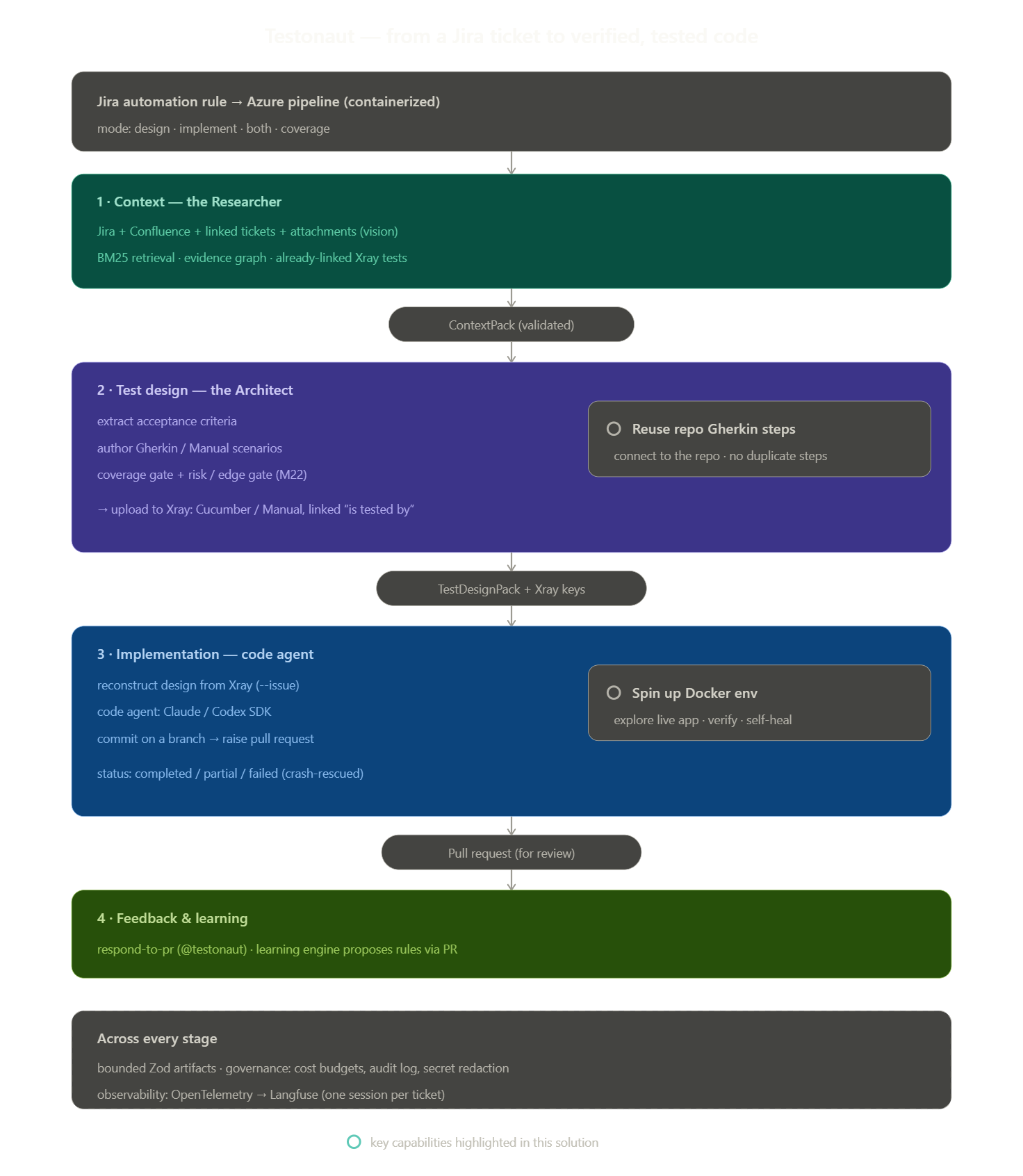
- Xray is the hand-off point between design and implementation. After design, implementation can run statelessly from
--issue <KEY>by reading the linked Xray tests. - Design is repository-aware. Testonaut scans existing
.featurefiles and reuses established Gherkin step phrasings instead of creating near-duplicate steps. - Implementation is environment-aware. A configured Docker setup command lets Testonaut start the app, explore real UI locators or API contracts, verify against the running system, and self-heal failing tests.
- Every mutating action is governed — Xray uploads, PR creation, learning proposals, and budget breaches are written to a redacted audit log.
- Every run is observable — LLM calls and agentic phases are traced with OpenTelemetry and grouped into one session per Jira issue in Langfuse.
New here?