
Agent Phases
Phase 3: Code Agent
TestDesignPack, follows the repository's .agents configuration and implementation skills, edits the test code, runs verification, heals failures, and optionally commits, pushes, and raises a pull request.The defining capability
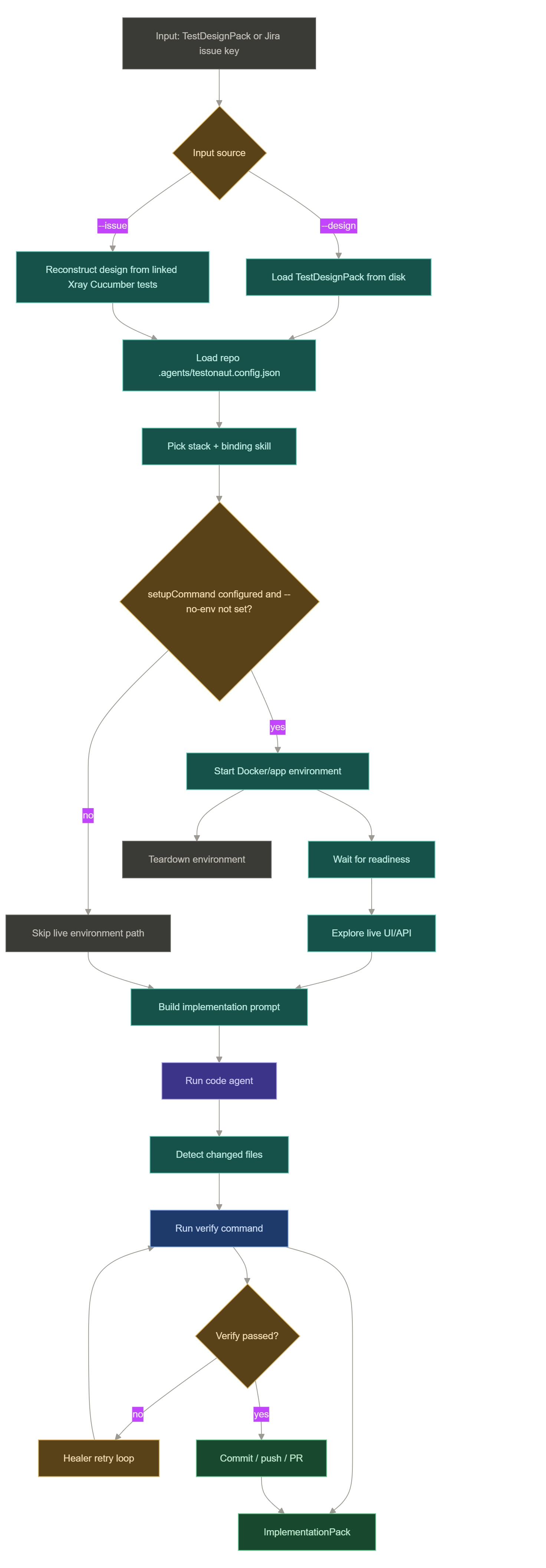
Inputs and outputs
| Item | Description |
|---|---|
Input: TestDesignPack | The design artifact from Phase 2, either loaded from disk with --design or reconstructed from Xray with --issue. |
| Input: target repository | The repo where the automation code will be written. Required. |
Input: .agents/testonaut.config.json | Defines stacks, verify commands, optional Docker setup/teardown, app URLs, MCP servers, policy, and PR gates. |
| Input: implementation runner | Claude Agent SDK, Codex SDK, or configured shell runner. |
Output: ImplementationPack | Changed files, scenario outcomes, verification result, heal attempts, branch/PR metadata, warnings, and provenance. |
| Output files | out/<KEY>/implementation.json, implementation.md, implementation.prompt.md, and optionally exploration.md. |
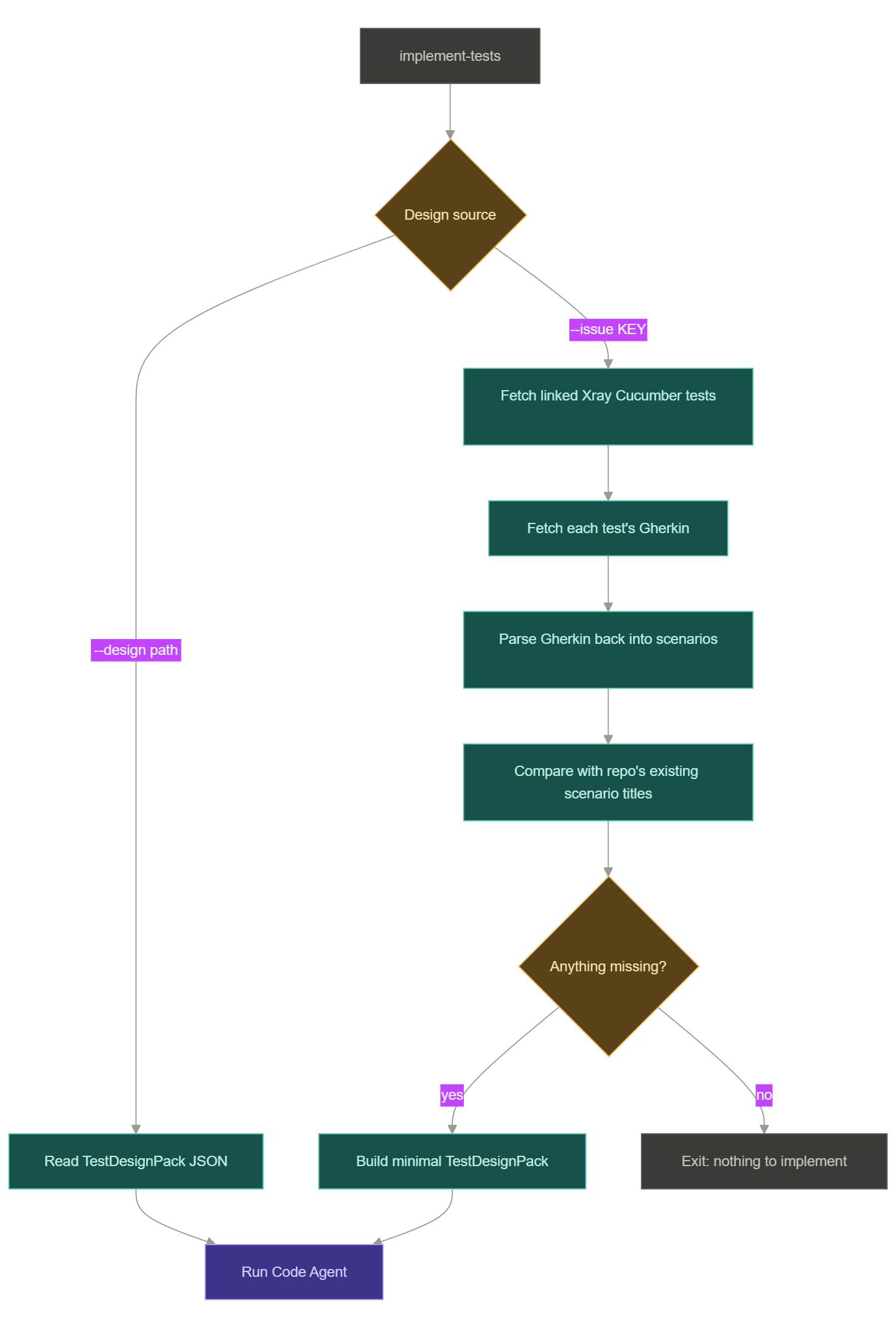
Design source: file or Xray
The implementation phase can start from either a local design file or directly from the story's linked Xray tests. The --issue path is important for pipelines — it makes implementation stateless: the design step can upload tests to Xray, and a later implementation rule can reconstruct the work from Xray without needing a local artifact hand-off.
Why configuration exists
The Code Agent cannot safely guess how a repository should be tested. Different repositories have different frameworks, folder layouts, verify commands, Docker commands, application URLs, and MCP tools. testonaut init --repo <path> scaffolds the .agents folder; stack detection can pre-fill basic entries, and teams then tune the config with the real commands and URLs for their app. A typical stack config:
{
  "id": "ui-playwright",
  "root": ".",
  "verifyCommand": "npm run test:e2e",
  "featureGlob": "features/**/*.feature",
  "kind": "ui",
  "setupCommand": "docker compose up -d --build",
  "teardownCommand": "docker compose down -v",
  "appUrl": "http://localhost:4200",
  "healthCheck": "http://localhost:4200/health",
  "readinessTimeoutMs": 480000
}
Key point
setupCommand and teardownCommand — the config is where you tell Testonaut exactly how to start the app and how to know it is ready.Environment-aware Docker flow
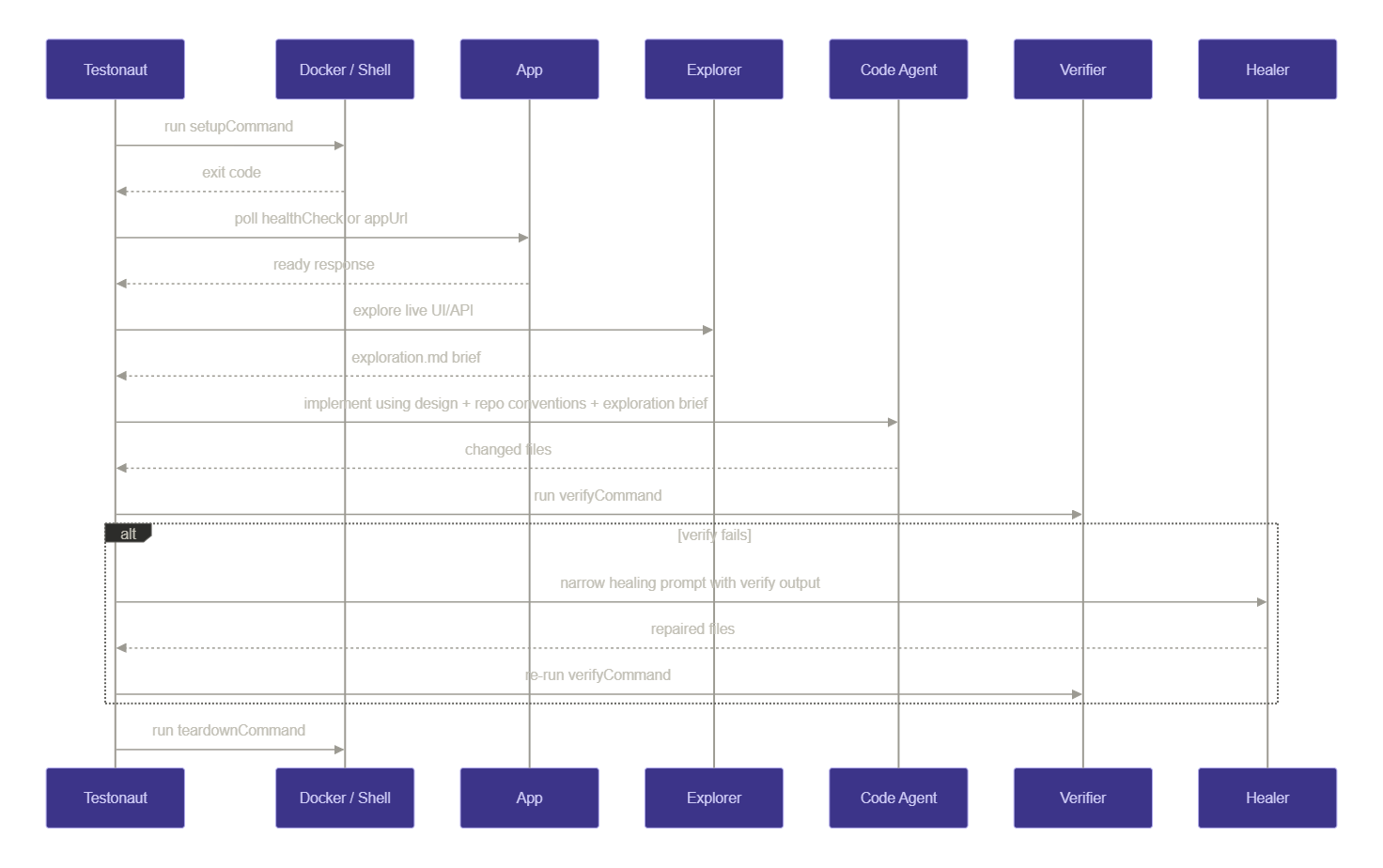
When a stack has setupCommand and the user did not pass --no-env, Testonaut attempts an environment-aware run.
Start environment
The environment manager runs setupCommand from the target repository root — usually docker compose up -d --build — then waits until the application is reachable. Readiness is checked against healthCheck when configured, otherwise appUrl. Any non-5xx response means the server is up and listening.
Readiness timeout
The default readiness timeout is 120 seconds. Some frontend stacks — especially monorepos or Nx apps that compile on startup — may need several minutes. That is why readinessTimeoutMs exists: if the app is slow, increase the timeout instead of letting the Code Agent implement tests against an app that never actually came up.
Teardown
After the implementation attempt, Testonaut runs teardownCommand if configured (best-effort, typically docker compose down -v). Teardown matters because these runs happen in CI and should not leave containers, networks, or volumes behind.
Why the Docker path matters
| Without live environment | With environment-aware run |
|---|---|
| Agent may invent selectors or endpoints. | Agent receives real observed locators/endpoints. |
| Verify may fail because no app is running. | Verify runs against the app started by Testonaut. |
| Failures are discovered later in human review. | Failures are fed back into the healer immediately. |
| PR can still be useful but is more speculative. | PR is backed by a real verification attempt. |
Explore before implementing
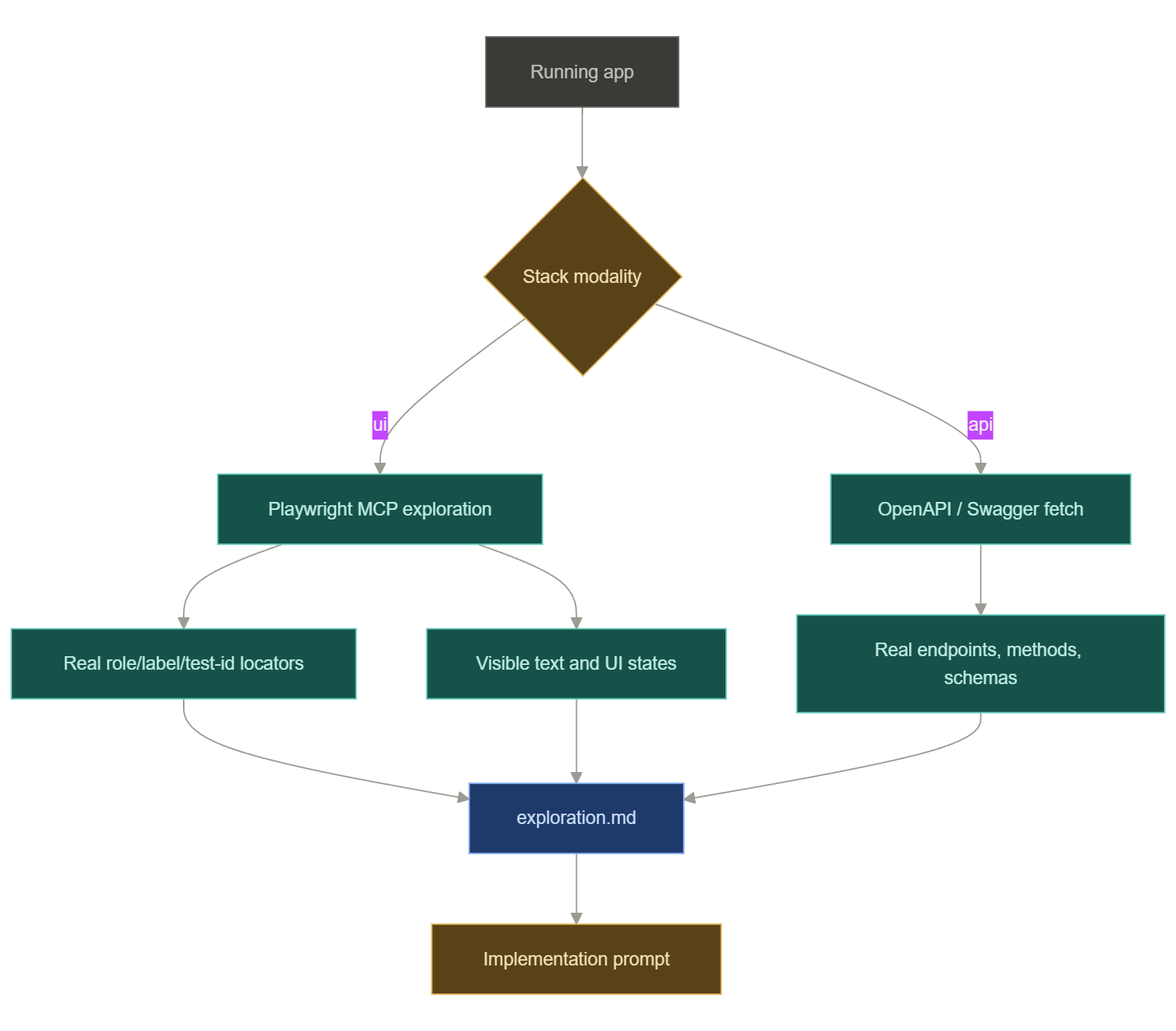
After the environment is ready, Testonaut tries to produce an exploration brief. This brief is injected into the implementation prompt so the Code Agent grounds its work in the real app.
- UI stacks: Playwright MCP opens the running app and reports concrete navigation paths, stable locators, labels, visible copy, and UI states.
- API stacks:
openApiUrlfetches the OpenAPI/Swagger document and summarizes endpoints, HTTP methods, operation names, request/response schemas, and payload shapes.
Implementation prompt composition
The Code Agent receives a structured prompt, not a vague instruction to write tests:
| Prompt section | Purpose |
|---|---|
| Goal and repository | Which repo the agent is editing and which ticket it implements. |
| Stack config | Stack id, root, verify command, feature glob. |
| Operating rules | Test-only edits, do not modify product code, do not weaken assertions, preserve traceability. |
| Binding skill | Stack-specific implementation contract, e.g. Playwright BDD TypeScript or Reqnroll. |
| Repository conventions | AGENTS.md, .agents/test-architecture.md, .agents/test-conventions.json, .agents/product-context.md. |
| Available MCP tools | Playwright, Figma, or other configured tools. |
| Live exploration brief | Real locators/endpoints/states from the running app or API. |
| Scenarios to implement | Full scenario list from the TestDesignPack. |
This structure keeps the Code Agent focused on implementing tests in the repository's style instead of inventing a parallel automation framework.
Verification and healing loop
Verification runs the stack's verifyCommand, unless the user passes --no-verify or overrides it with --verify. The verifier captures command, exit code, duration, stdout, and stderr.
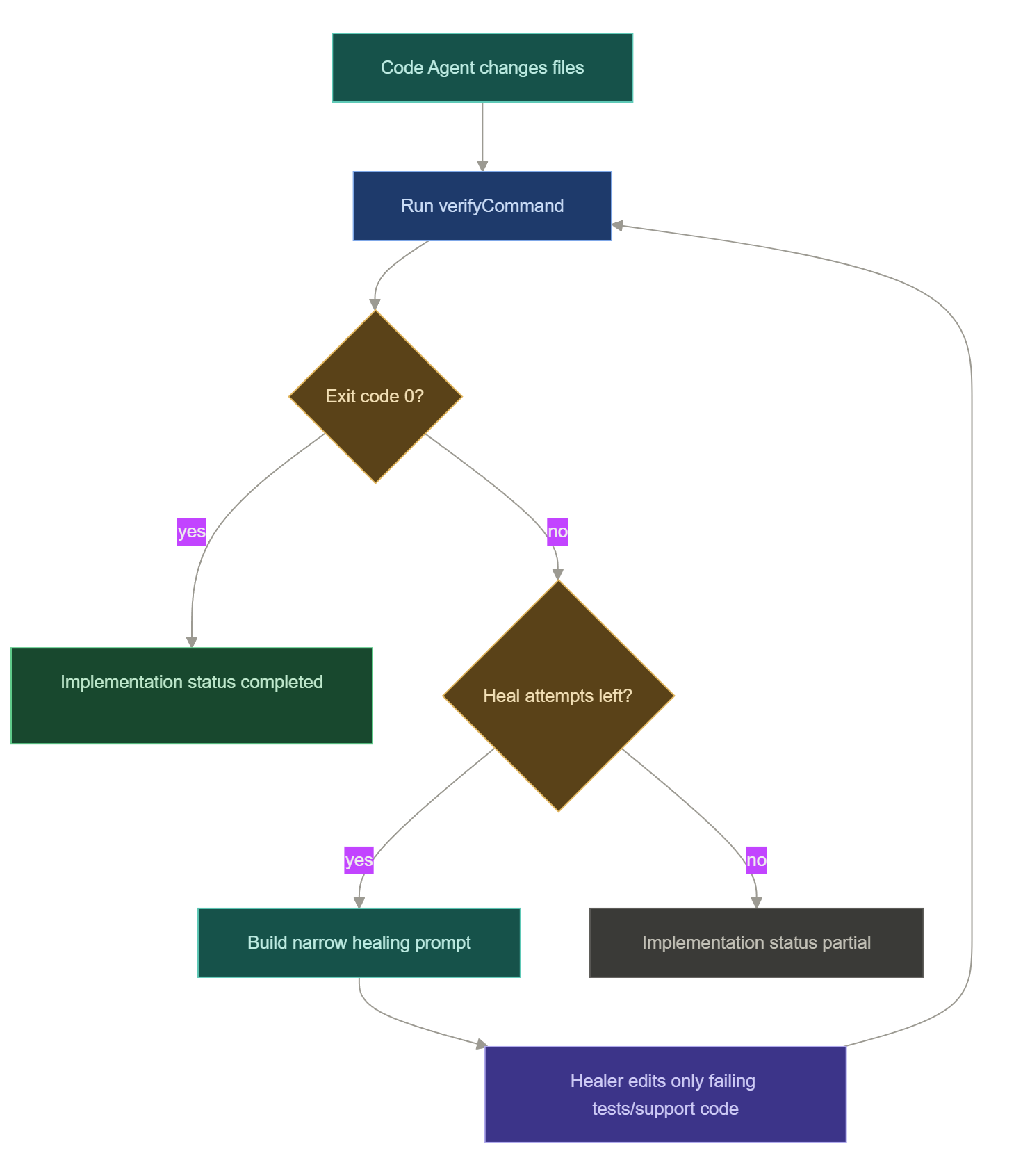
If verification fails, the Healer receives a narrow prompt containing the failing output and the changed files from the previous attempt. It is explicitly told to repair only the failing tests or test-support code — not to restart the implementation, change product code, weaken assertions, skip scenarios, or disable retries just to get green. The default healing budget is one attempt, controlled by --max-heal-attempts.
Graceful fallback behavior
The Docker path is best-effort — Testonaut still produces a useful PR when the environment cannot run:
| Situation | Behavior |
|---|---|
setupCommand is missing | Skip the environment-aware path and implement normally. |
--no-env is passed | Skip Docker setup even if configured. |
| Docker command fails | Continue without live exploration/verify environment and record a warning. |
| App never becomes ready | Continue without live exploration and record a warning. |
| Playwright MCP is not configured for a UI stack | Skip UI exploration and record a warning. |
openApiUrl is missing for an API stack | Skip API exploration and record a warning. |
| Verify fails after the healing budget | Status becomes partial; a PR can still be raised for human review. |
Reading a green run
exploration.md or the implementation artifact shows that the environment started and exploration/verify happened against it.Branch, commit, push, and PR
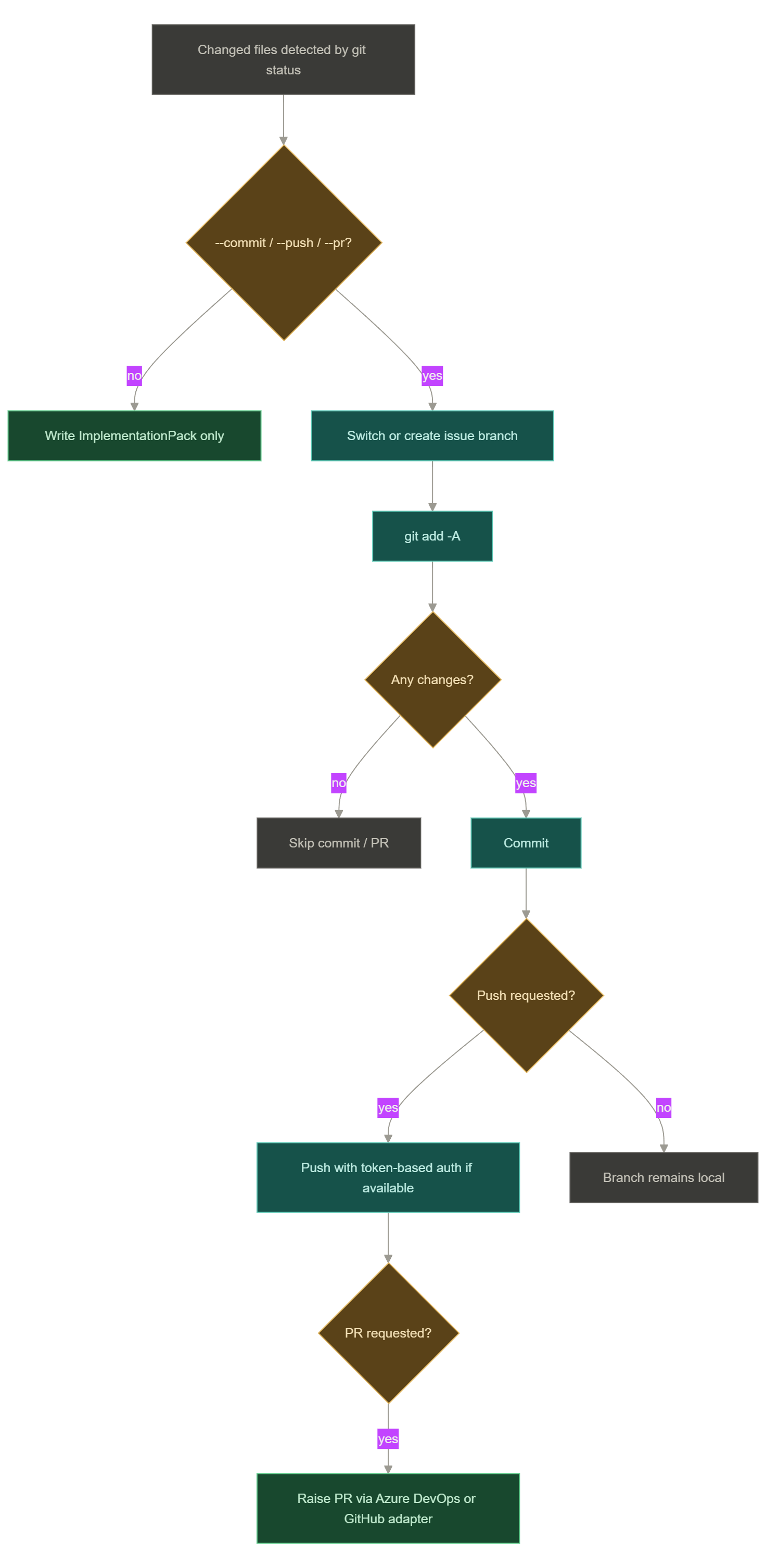
After implementation, Testonaut can create a branch, commit changes, push, and raise a pull request. For unattended pipeline runs, the VCS token authenticates both REST operations and git push — injected as a redacted http.extraHeader, never written into the remote URL. The PR platform is resolved from the repository remote and can use Azure DevOps or GitHub adapters.
Crash rescue
The implementation agent can occasionally exit non-zero after making valid changes — for example, if an agent transport drops near the end. If the agent reports failure but verification passed and files changed, the final status becomes partial instead of failed, so the branch and PR can proceed for human review rather than discarding working verified code.
ImplementationPack
| Field | Meaning |
|---|---|
ticket | Jira key and title. |
stack | Stack id used for implementation. |
repoRoot | Target repository path. |
status | completed, partial, failed, or dry-run. |
implementation | Code-agent command result. |
verification | Verify command result, when run. |
healingAttempts | Each healer run and its verification result. |
changedFiles | Repo-relative files changed by the agent. |
scenarios | Per-scenario implementation status. |
pullRequest | PR branch, target, status, URL/id/message, when requested. |
promptPath | Path to the implementation prompt used for traceability. |
warnings | Environment, commit, crash-rescue, or other non-fatal warnings. |
CI requirements for Docker-backed verification
| Requirement | Why it matters |
|---|---|
| Docker available on the runner | setupCommand usually calls Docker Compose. |
| Hermetic compose files | Hosted agents do not have sibling repos or local-only bind mounts. |
| Published host ports | appUrl / healthCheck must be reachable from the Testonaut process. |
| Required secrets mapped into the pipeline step | The app may need auth, API, or database credentials at startup. |
| Realistic readiness timeout | Slow frontend builds may need several minutes. |
| Teardown command | Prevents leftover containers, networks, and volumes. |
Why this phase matters